Pensive pedaling (Loop 1)

My husband and I got dressed and lathered up with sunscreen for a bike ride, but when he went to retrive his bicycle it had a flat. So he decided to run laps at the high school and I headed off on my own.

I took a familiar route, one of several Dan and I have frequented over the 17 years we’ve lived in our house, which is located near Tatum and Shea Boulevards. About three miles into the ride (which is about how far it takes me these days to warm up and stop feeling old), I reached the shady, tree-lined path running east on Doubletree Ranch Road. I passed Rotary Park and was slammed by an emotional response so powerful it took my breath away.

We gathered at the park for a goodbye party for my friend whose family was moving out of town. We ordered pizza and watched the kids play in the sand. Then we perched our laughing preschoolers — my two sons, her son and daughter–on the bench of a picnic table and snapped a photo. My friend’s son is now dead at the age of 24, the apparent victim of a drug overdose. The picnic ramada where we photographed our children is still standing. Why is is that her beloved child is not?

A right turn on the path took me past several man-made lakes and out onto McCormick-Stillman Parkway. There is a McDonald’s where the parkway intersects with Hayden.

My son David and I decided to ride our bikes to McDonald’s for breakfast. I had to drag him out of bed so we could leave before the day’s heat set in. It was the longest ride he’d ever attempted, this small child who had barely left his training wheels behind. But he made it. And never has an Egg McMuffin tasted better.

Heading south on Hayden, I pass a dad and his son riding together. We exchange smiles. I stop at the light at Indian Bend Road, noticing that the road to McCormick-Stillman Railroad Park has reopened after months of construction. The path south meanders through a public golf course before it dips under a bridge at McDonald. My dentist of nearly 20 years, Kathi Mansell, has an office just a block or so over.

The hygienist had finished cleaning my teeth when Kathi came in to do a quick check. When she was done, she asked about my in-laws, who became Kathi’s patients when they retired to the Valley. She was concerned about my father-in-law, whose health was deteriorating. When Tom died, I called her office to share the news — hoping to spare her staff, and my mother-in-law, the awkwardness of a phone-call reminder for an appointment no longer needed. The receptionist was genuinely troubled by the news. “We loved Tom!” she exclaimed.

“On your left!” I shouted as I approached a young couple walking ahead of me. “Thanks!” I sped past them, approaching the right turn at Jackrabbit. Just a few blocks later, I reached the canal, which forced me south to Chaparral, where I turned west.

Nancy Melvin had a condominium near here. She was a Ph.D.-level professor in the nursing school at ASU and somehow she found out about our magazine, which was not yet even a year old.  She called me one day to tell me about research she was doing on child temperament. It was amazing. She had developed tools to help parents understand why their child responded to particular situations based on inherent temperamental characteristics. Understanding the “why” helped her team develop strategies for supportive parenting, so parents would know, for example, how to help a slow-to-warm child who had trouble developing friendships. Lisa Sorg-Friedman wrote a fascinating three-part series for the magazine and for several years I maintained a friendship with Dr. Melvin, meeting her occasionally for breakfast or lunch. She was always deeply interested in the magazine’s progress. Eventually, we lost touch. And a few years ago, I heard that she had died. ASU endowed a professorship in her name called the Nancy Melvin Professorship in Pediatric Nursing. In reading more about her, I learned that she educated the first pediatric nurse practitioners in the Valley. I don’t remember if I knew that. What I do remember is that she loved working with children but never had any of her own.

My chain slipped as a crossed the busy intersection at Scottsdale Road. Embarrassed, I propelled the bike forward by pushing off with my left leg. Thankfully, the momentum righted the problem.

A talented architect lived near here. I met him while serving on a committee I dubbed H.I.K.E.R.S. (Hikers Intent on Keeping Everyone’s Rights Secure). The group formed in response to a neighborhood’s effort to prevent hikers from accessing the Cholla Trail up the back side of Camelback Mountain. For weeks, we attended city council meetings and passed out flyers at Mountain Preserve trailheads to educate the public ab0ut the situation, eventually winning a compromise on parking restrictions that pacified the homeowners. One of the key spokespersons for our effort was Phil Richards. His ex-wife, Frankie Mae, recently joined the sales staff at Raising Arizona Kids.

I wasn’t planning to ride any hills but found myself pulled toward the winding roads and distraction factor of mansions along the winding roads in the tony neighborhoods sandwiched between Camelback Mountain’s north side and McDonald Road. This decision forced a steep climb as a street called Starlight veers higher toward what was once John Gardiner’s Tennis Ranch and is now Sanctuary Camelback Resort & Spa. At the very top of the hill, where Starlight intersects with Dragoon, a modern-architecture home is tucked against the slope.

Dan’s parents had rented a beautiful house for more weeks than they could use it, so we started spending our weekends there. The house had a pool and splendid views and escaping to it was like taking a vacation. One night, as we pulled into the driveway, we thought we saw something jumping off the roof. A coyote? A cacomistle? When we got inside, we saw a pillowcase in the hallway, and a sickening realization dawned. We’d been robbed!

The original house, of course, is no longer there–this new, much larger, home stands in its place.

The whoosh and freedom of the downhill is worth every bit of sweat equity invested going up. I paused briefly at McDonald before heading west to 54th Place and north to Lincoln. Waiting for the light to change at the entrace to Camelback Inn, I remembered that it was my first choice for a wedding reception.

After various family members weighed in, the location was changed, but I always wondered what it would have been like to get married at sunset on the grass at the center of this glorious resort. Decades later, I found out, when our former babysitter married her longtime sweetheart in exactly the type of service on the lawn that I’d imagined for myself.

Older and wiser, I realize it is the marriage–not the wedding–that matters. And yet I wonder. Why I gave in. Why I gave up. I wouldn’t do it now.

_______________________________________________

The events in our lives happen in a sequence in time, but in their significance to ourselves, they find their own order… — Eudora Welty

Inspiration from the inspired

Marion Wright Edelman

Marion Wright Edelman (left of podium) is introduced as commencement speaker at Whittier College in Whittier, Calif.

Marion Wright Edelman, founder of the Children’s Defense Fund and a leading advocate for children and the disadvantaged, gave the commencement address at my son David’s graduation from Whittier College last month.

This woman is a hero in the field of early childhood education. She is a visionary whose views have guided much of the current thinking about what children need to develop into healthy, productive adults. I found myself hanging on every word.

She told many stories from her childhood, which included just 14 short years with her father. He died en route to the hospital while insisting, in his last words to a young Marion, that she let nothing get in the way of her education.

Edelman made many admonishments to the Class of 2009. Perhaps my favorite was this: “Instead of spending your time and energy trying to find yourself, why not try to lose yourself — in service to others?”

She also had a great story for parents wondering how to keep their kids reading this summer. Wright Edelman came from a family that disdained idle hands and minds. She and her siblings were allowed a reprieve from chores “only if we were reading.” She paused, then added, “We did a lot of reading.”

Looking for a summer reading program? Check out our directory of programs in Maricopa County.

No black-and-white answers

It wasn’t at all what I expected.

Brittney Walker and I attended Monday’s “Safe Sleep Symposium” at Scottsdale Stadium. The educational event, organized by the Arizona Department of Health Services, pulled together professionals from many fields — medicine, social work, emergency response, child protective services and more. Their goal? To figure out what kind of educational outreach would be most effective in reducing the incidence of infant deaths from Sudden Infant Death Syndrome (SIDS) and tragic, sleep-related accidents.

Remember the Back to Sleep campaign? That effort has been hugely successful in reducing the number of SIDS deaths from suffocation. Moms and dads were told that it’s safest to put babies to sleep on their backs, rather than their tummies. The overall rate of SIDS deaths has declined dramatically since 1994, when the Back to Sleep message was first promoted. But now another, just as devastating, statistic is rising: child deaths that occur in adult beds.

It goes by many names — co-sleeping, co-bedding, “the family bed.” And it’s practiced in many cultures around the world. Here, it’s practiced by parents who seek  convenience (for breastfeeding moms) or a strong, loving bond with their children.

It’s a very personal choice, and one that clearly comes with risks. An emergency responder who spoke at the conference described finding a child who’d been suffocated by the weight of an adult who rolled over onto him in the middle of the night. Children have suffocated from loose or heavy bedding in an adult bed — or from becoming wedged between the bed and the wall. So I was expecting the professionals at the Safe Sleep Symposium to be adamantly united in a message against co-sleeping.

But they weren’t.

Brittney (an admitted co-sleeper who began the practice out of desperation when she was pushed to her limit by a baby who would scream for five and six hours each night) was part of a panel of woman who’d made the same choice and were there to explain it. I was sitting in the back of the room during the discussion, waiting for my turn to talk during lunch about “Messaging for the Media.” I was astonished, as I listened and watched, to see many of the heads in front of me nodding in agreement as Brittney and the two other women defended their co-sleeping practice.

By the time the panel ended, I was completely dumbfounded. You expect the pros to be very black and white about rules. Especially when it comes to safety. But they weren’t. They acknowledged that there are many positives to co-sleeping, and sometimes many economic reasons why it’s the only choice. (Some families, obviously, can’t afford cribs and separate bedrooms for their children.)

So it’s a tricky message they have to craft: that co-sleeping can be dangerous but there are ways to make it less so. Like never bringing a child to your bed when you’ve been drinking alcohol or taking sleep-inducing drugs. Like making sure you have a firm mattress (no cushy pillow top!) and there are no fluffy pillows or heavy blankets anywhere near the baby. Like positioning the baby near your waist, not your face.

One nurse I spoke to before I left told me that she thinks of it the same way she does many other safety hazards. Take ATVs. “I’ve seen so many accident victims,” she said. “But what are you going to do? Tell people they shouldn’t have ATVs? Or that their children shouldn’t be allowed on them? At least they’re out there pursuing a family activity that they enjoy doing together.”

If we wanted to keep our children 100 percent safe, we wouldn’t let them ride their bikes or roller blade or skateboard or cross the street, for that matter. Instead, we teach them the safest methods for navigating their lives. We make them wear helmets and we teach them safety rules. We take precautions on their behalf and we follow the safety rules ourselves. And we hope for the best.

Download the National Institute of Child Health and Human Development brochure “Infant Sleep Position and SIDS.”

Bragging rights

I’ll happily acknowledge my six degrees of separation on this one but I’m going to brag anyway. Raising Arizona Kids has published the works of a Pulitzer Prize-winning journalist.

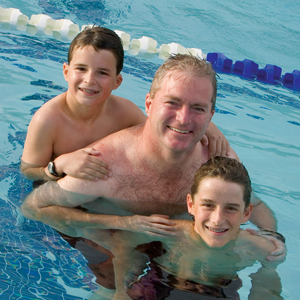
Paul Giblin and sons in 2006.

Paul Giblin and sons in 2006.

Our June 2006 Father’s Day issue included several Q&A essays written by local dads. One of the essays was written by then Tribune News reporter Paul Giblin. 

Giblin and colleague Ryan Gabrielson were recently honored with the Pulitzer Prize — the granddaddy of all prizes to professional journalists — for a series of articles they wrote in 2008 criticizing Maricopa County Sheriff Joe Arpaio.  The awards committee noted “their adroit use of limited resources to reveal, in print and online, how a popular sheriff’s focus on immigration enforcement endangered investigation of violent crime and other aspects of public safety.”

Ironically, as the New York Times reports in today’s business section, Giblin was one of many reporters laid off when the Tribune, owned by Freedom Communications, downsized in January. Giblin and a few colleagues now run The Arizona Guardian, a news website focusing on Arizona government and politics.

For our story, Giblin described the most difficult aspect of being a dad. He said it was “trying to set an example all the time” for his sons Casey and Tim. Reaching the pinnacle of one’s profession is setting a pretty good example of what can happen when you work hard, care a lot and give it everything you’ve got. So I’m sure the old man has made his sons proud. But I’m guessing it’s not just because he won a prestigious award. They saw him absorb a tough blow, pick himself up and — taking no time for self-pity —  move on. I can’t think of a better example than that.

Moments of exasperation

The Oki printer hates me. Especially on Monday mornings, when I need it most.

We have 10am staff meetings every Monday. These meetings are very important to me. It’s a time to get everyone on the same page, share concerns, problem-solve as a team and set the tone and direction for the week ahead. I stress about these meetings because I want them to run smoothly. No one on my team has time to waste and I certainly don’t want to be the catalyst.

So I spend quite a bit of time each weekend preparing. Culling through emails from the week before, sifting through notes I’ve plopped into my “meeting agenda” folder, printing handouts everyone will need to make informed decisions. No matter how much I do ahead of time, I rarely achieve the flawlessly efficient meetings I crave. And I’m often late getting them started.

So I blame that darn Oki printer. I bought it in haste a few years ago when our old printer conked out and we had a deadline to meet. I didn’t do any research. I didn’t go online to read the blogs or visit Consumer Reports. (Neither of my brothers will make a purchase without taking both of these steps.) I think the Oki senses my utter lack of regard, so it punishes me every Monday, when I inevitably discover just one more document I need to print for my staff meeting. It simply won’t print from my computer.

Mala, our calendar & directories editor, is the computer’s muse. She seems to be able to coax it to do anything she wants. But she is nice to it. She nourishes it with new cartridges, fills its paper tray, talks to it in soothing tones. I flail around the office in a panic, saying to anyone within earshot, “This darn thing won’t print again!”

Inevitably, it works absolutely fine as soon as our meeting has ended.

There are many moments of sheer exasperation when you’re trying to run a company. I’ve been going through some of my old RAK History files, laughing as I read and remember some of them. Here’s one example.

On a Saturday morning in 1991, I  was driving up the Dreamy Draw (now Piestewa Peak Freeway). I had just picked up a load of magazines from the printer. (I can’t remember now why I would have been doing this on a Saturday.)

The back of my mini-van popped open, spilling boxes of magazines onto the heavily traveled road. Both my sons were in the car with me, safely strapped into car seats (thank goodness). So I took them home to Dan and went back by myself, recklessly darting into the road to recover as much of our precious inventory as I could manage. Many boxes worth were ruined or lost.

It’s funny now. It wasn’t so funny then. So maybe some day I’ll be able to laugh about the Oki printer, too. 

Taking the hard knocks

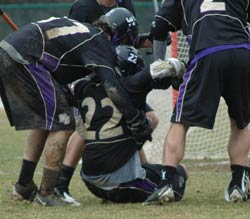
090328_goucher_gameTOWSON, Md. – Yeah, that’s my kid. Number 22. The guy who’s struggling to get up.

My husband and I are staying in Baltimore for a week so we can enjoy our son David’s last hurrah as a collegiate athlete. His lacrosse team, the Whitter Poets, has traveled to the East Coast for a four-game swing through Maryland and Delaware. It’s a “two-fer” for us because our other son, Andy, works in Washington, D.C., a mere hour’s train ride away. Yesterday, all three of us were able to attend the Poets’ game in Towson against the Goucher College Gophers.

The day was rainy, drizzly and dreary. I’ve been battling a bad cold since the middle of last week. But the game was fast-paced, competitive and exciting, so all those extraneous factors quickly drained away as I pulled out my camera and starting snapping pictures.

I positioned myself at the end of the field where the defensive players hang out. David is a “long pole” whose job is to protect the goalie. I was fiddling with my camera settings when I looked up and saw him crash — hard — into a Goucher player.

I quickly lifted my camera, knowing the long lens would give me a close-up view so I could figure out if David was really hurt. At first, he started to get up. Then I saw him slump and fall back to the ground. With the help of some teammates, he was soon back on his feet and limping slowly back to the sidelines. Not 10 minutes later, he was back in the action.

After the game (which Whittier won 10-9), we asked him what had happened.

“I blacked out,” he said. “I’m fine now.” Visions of poor Natasha Richardson filled my head and mommy-paranoia bubbled to the surface. “Are you sure you don’t have a concussion?” I demanded. “Do you need to go to the hospital?”

“Mom. The trainer checked me out. I’m fine.” This from the guy who had told me just a few hours earlier that he “might” have a broken heel from a collision in last week’s game against Union College. The guy who opted not to get an x-ray because he’s a senior and a confirmed diagnosis would end his season. The guy who’d rather hurt like heck than know for certain that his days as a scholar-athlete are over.

I never played a team sport and I can only imagine the guts it takes to persevere past pain and disorientation, to request more playing time even when it could mean further damage to an injured body (or brain). I don’t know where he got that determination.

And yet I wonder. My son has watched for years as I’ve struggled to keep my little business alive. He’s seen me work long past the point of exhaustion, ignoring hunger, illness and physical discomfort because something needed to get done. He seen me persevere past seemingly insurmountable barriers over which I had no control. I kept getting up the next morning and going back for more. He saw that.

There are many ways to take the hard knocks. When you know the end result is worth any temporary inconvenience to self, you don’t even give it a second thought.

Speaking up–finally

I used to work for the Arizona Republic. In fact, my husband and I fell in love while co-writing middle-of-the-night reports about homicides, fires and robberies. (He was in the field; I was at the night rewrite desk.)

We left the Republic to pursue graduate school (a law degree for Dan, an MBA for me). Seven years and two children later, I started Raising Arizona Kids Magazine.

I held my tongue as I watched what evolved at the Republic over the next few years. Raising Arizona Kids pioneered one project after another–comprehensive calendars of events, annual summer camp directories, birthday party resource guides and more–only to see our ideas duplicated in the larger and more efficiently distributed daily newspaper. I held my breath and suffered countless sleepless nights when the Republic (through its magazine division) started a monthly magazine for parents in the East Valley. (Our Kids lasted less than a year before it was yanked for failure to thrive.) And then came the final blow. The Republic claimed moms for its own, providing “new” resources online that we’ve offered decades–but with the advantage of huge teams of web-savvy professionals who could add all the bells and whistles (if none of the depth). Versus me and one part-time IT guy.

But now I’ve really had it. The Republic, in the Gannett model of market-research-driven, increasingly superficial and fluff-oriented journalism, has gone too far. In this month’s az magazine (which is devoted to “buzz, people, style and culture”), self-annointed parenting expert Karina Bland advocates a parenting strategy designed to put children “Ahead of the curve” by enrolling them in what she describes as “10 of the Valley’s best enrichment programs to help your child beat the competition.”

I felt physically ill as I read her describe how today’s parents will “do just about anything to help [children] get a leg up on the competition–even it if means instruction in Mandarin well before they’ve mastered English or college classes before they’re old enough to drive.”

It’s not that the 10 places she lists are bad places (although I know from receiving the same press releases she gets that the Bambini Language Immersion Preschool she recommends just opened on Nov. 17th, so how it can be the “best” with no track record floors me.) It’s her premise that the only way to be a good parent is to push your child to be better than everyone else.

The irony is striking as I proofread copy for our February issue. We have an article by Scottsdale early childhood education expert Melanie Romero, who through both education and experience is far more qualified than Karina Bland to tell parents how to best approach their parenting. In “Parenting on Overdrive,” Melanie rejects the strategy of trying to raise super kids (a concept, frankly, that was on its way out 23 years ago when I had my first child). To quote from Melanie’s article: “Parents who over-schedule their children or push them to achieve risk creating young people and adults with chronic stress, burnout, low self-esteem and lack of creativity.” She condemns “hyper-parenting,” a phrase first coined by Alvin Rosenfeld, M.D. and Nicole Wise in their book The Over-Scheduled Child: Avoiding the Hyper-Parenting Trap.

When I attended journalism school I was taught that professionalism dictates objectivity, despite your own innate preferences and choices. My staff has been trained to work this way. We believe that parenting is a serious and carefully cultivated skill enhanced by exposure to different professional opinions. We consciously choose to avoid recommending any one approach or hyping something as “best” because we know that all parents are different, all children are different, all families are different… and what works for one does not necessarily work for another. We strive to be a place for the exchange of ideas, rooted in a professional perspective provided by local experts we interview or whose articles we publish. We expect that our readers will ponder the options and strategies we describe and choose wisely from their own insights about their respective situations.

In this blog-eat-blog world, we increasingly accept as “news” and “fact” the opinions of people whose intelligence and personal experience often encompass no more than the ability to type and hype. It saddens me that the Republic has such a large and powerful platform on which to promote what their marketing department has determined will sell magazines.

I refuse to relegate my parenting — or my company — to that model.

A light at the end of the tunnel

It happens every  year, no matter how hard we plan and scheme to avoid it. It sucks away our weekends, our evenings and sometimes, it seems, our sanity. It’s when we start apologizing to each other for our meltdowns. And when many of us succomb to colds and flu. We always reach a point when we wonder, “is it worth it?” And then the first steps of closure quietly arrive. Our spirits are revived. Laughter fills the hallways. And poor Mala’s bloodshot eyes start to clear up and regain their sparkle. Continue reading